|
|
|
|

|
Los Glaciares National Park
Handling
plan |
|
| |
|
 The
Park’s area and surroundings have a severe
hunting pressure history because of the
“estancias” settlement. On the other hand,
cattle and non-traditional tourist activities
worsen the conservation of the Park’s fauna.
In order to control and revert this situation,
the park has a recovering plan. The
Park’s area and surroundings have a severe
hunting pressure history because of the
“estancias” settlement. On the other hand,
cattle and non-traditional tourist activities
worsen the conservation of the Park’s fauna.
In order to control and revert this situation,
the park has a recovering plan. |
|
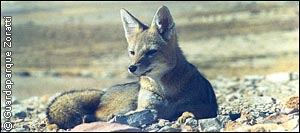
Gray
fox. |
|
|
| |
| Uses and conservation states |
|
There
have been, and it is likely to persist, intense fox,
guanaco and puma hunting.
As a testimony of the severity and lasting of this pressure,
Prichard (1902) said "two pioneers killed 73 pumas during
a winter near Lago Argentino"...
Referring to the huemul, Serret’s report (1996)
mention the problems of conservation of the population
to the west of Lago Viedma; as a consequence of the
wild horses in the area and the livestock activity in
the nearby estancias. These circumstances produce a
greater vulnerability to the predation of the puma.
It is also harming for this specie the increasing
non-traditional tourist activities and the lack
of control because of the absence of Park rangers in
some of the sections. |
|
 Up Up |
|
| Recovery Program |
|
To
revert the processes mentioned above, these programs
are being run:
A. Protection of the huemul population
- Guarantee the observance of people
trespassing the west area of Lago Viedma between
Seno Moyano and Glaciar Viedma, including the intangible
area and strict natural reservation.
- Evaluate, in this area, the alternative
of a more convenient handling of wild horses. Their
permanence could cause, because of competence, the
huemul population, but on the other hand, their
eventual removal could induce a greater predation
of pumas over huemuls.
B. Complete vertebrate catalogue
The vertebrate catalogue is still not complete. Having
a list of species in the Park is a basic need to know
the fauna being protected. It should be taken into account
that this catalogue is almost complete for birds and
amphibians, lacking information on reptiles, mammals
and fish.
The remaining tasks are:
- Make an reptile and fish catalogue.
- Complete the small mammals catalogue.
- Make the birds catalogue for
high environments and in the National Reservation
– Northern Area.
C. Determine the presence
of two bird species in risk of extinction in our country
The Austral Rail (Rallus antarcticus)
and the Cordilleran Snipe (Gallinago stricklandii)
have been considered respectively in Argentina “in risk
of extinction” and “vulnerable” by the Wild Fauna Regional
Patagonic Council (1995).These two species, rarely known
in our country, could be found in the National Park.
Their localization could be very important for their
study and conservation.
To accomplish this, it would be necessary to:
- Make a bibliographic research
on the existing data about both species, to make
a guide to find the environments, and to search
and identify the species.
- Make, all year long, an exhaustive
revision of the environments identified as possible
homes for these species.
- Allow the participation of independent
investigators in the search of both species.
D. Study and evaluate the
choique’s population
The choique is a vulnerable specie, rarely represented
in other protected areas in the country. Los Glaciares
National Park, with a significant steppe area , is one
of the protected areas with a high importance for this
specie. It is necessary to evaluate the population,
because of the intensive use of the land for livestock.
The following tasks are to be completed:
- Evaluation of the habitat use,
distribution, movements.
- Evaluation of the influence of
livestock of the habitat and choique’s population
- Propose of handling plans.
|
|
| Up |
|
| Source:
Los Glaciares National Park |
| |
|
|


